Before the plays were given over to the Guilds, the Clergy would perform the plays. I would be easy for me to imagine that they would have been better than the average, unskilled person. Once the papal edict of 1210 appeared though, and the Guilds gained control of the plays, the people who became the actors in the plays were just that, the average person, not trained in acting and generally nothing theatrical related. The number of actors was also unimaginable to people of our time, where in The Acts of the Apostles there were 494 different roles, and most likely because there were so many unskilled people as actors, they distributed the roles to 300 actors. It seems to me that if there had been such a thing as the professional actor at the time, the number of actors actually needed would have been considerably less, but this was how it was at the time and nonetheless that is an amazingly large amount of people.
It is also interesting to note from Brockett on page 94, that in 1476 the city council decided that four of "the most cunning, discreet, and able players within this city" were to be the ones who would do the auditioning of the actors. As Brockett notes, it seems to mean that the guilds did not in fact keep the casting to themselves, or even to the people within their guilds, but the entirety of the city was involved.
Tuesday, December 7, 2010

Scenery
Upon each of the stages, whether it was moving or fixed, there were two different and basic places, the scenic unit, or the mansion, and the acting area, or the platea. On each cart, there was usually only one mansion, though if made much larger, multiple could have been on a single cart. Fixed stages are a completely different story, able to have many different mansions on it at once, and able to change them out as the play went along. Brockett also brings up an interesting question, on page 89, that in the play presented at Lucerne (as an example) in 1583, that there were about seventy different locations indicated within the text, and yet there was only thirty-two mansions. This could very well be that they would reuse a single mansion for multiple locales, only name it differently when brought up onstage. That was my thought on it, but Brockett also considers that the identity of a number of the locations might have been clear to the audience without a mansion.
Spectacle
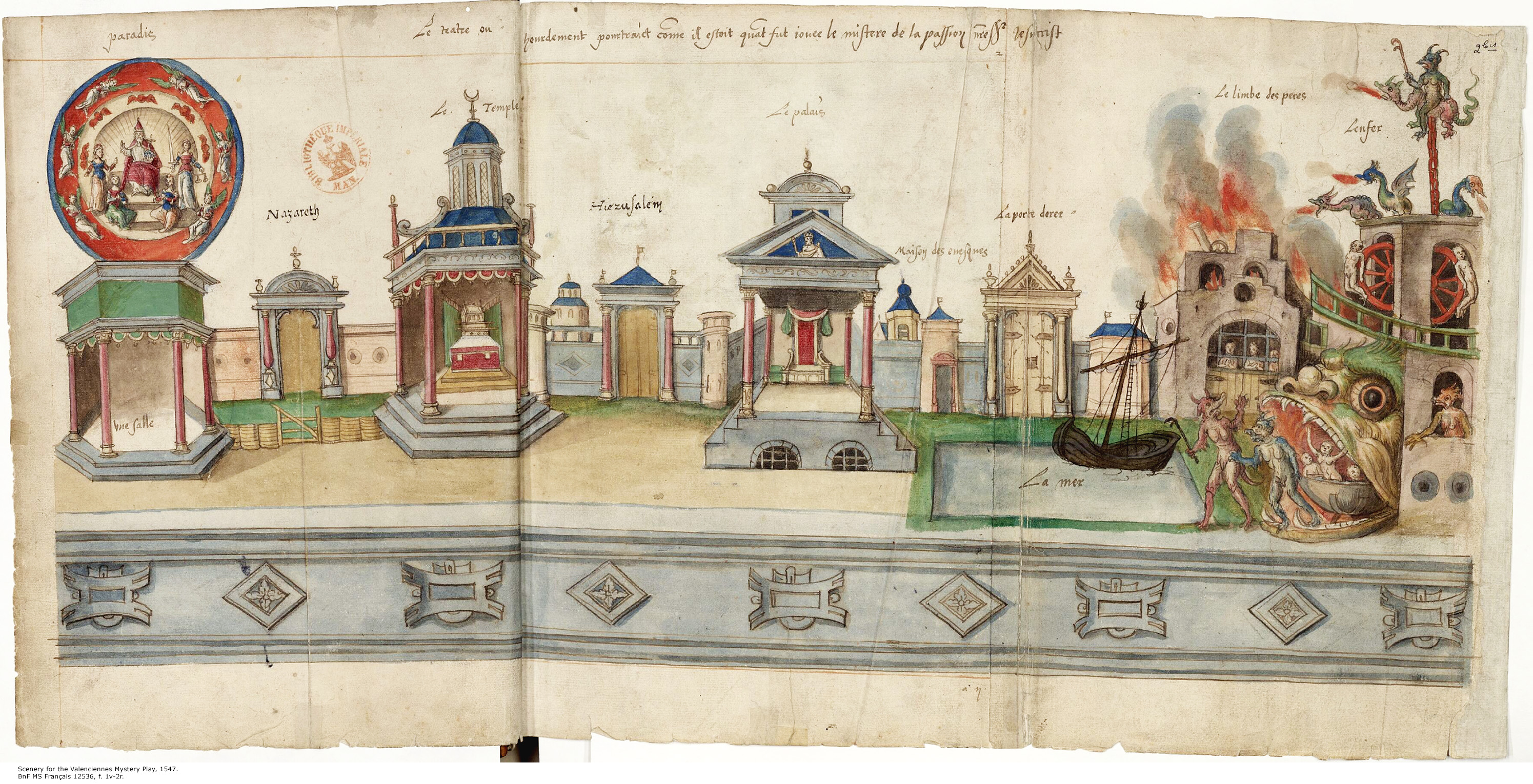
Most likely the most popular part of the plays was the spectacle that they presented to the audience. Anything that was supernatural the the Bible described happening they actually had happen onstage. Things like turning water into wine, a constant 5 minute rain for Noah's flood, Jesus walking across water, the apostles filling their nets with fish, and they would even burn buildings, wicker versions that they actually set on fire. From the creation of trap doors and mechanisms that 'flew' people up to Heaven and back down again, to creating effigies of people, filling them with animal bones and entrails, and burning them for a realistic smell (Brockett pg. 91). Below is an image of the stage of the Valenciennes Passion Play in 1547, to give an idea of the kind of spectacle put on.

In our day and age, we may have a few of these things in our plays, but never could we actually burn anything in a controlled fire onstage for fear of starting a larger, uncontrolled one. All of this would also cost us ludicrous amounts of money in which the theatre doesn't generally have at it's disposal any longer unless it's on Broadway. Though something to think about, is really this was the Broadway of it's time, the entire city, and most people outside the city in other towns and villages, would come to see these plays for days on end.
In our day and age, we may have a few of these things in our plays, but never could we actually burn anything in a controlled fire onstage for fear of starting a larger, uncontrolled one. All of this would also cost us ludicrous amounts of money in which the theatre doesn't generally have at it's disposal any longer unless it's on Broadway. Though something to think about, is really this was the Broadway of it's time, the entire city, and most people outside the city in other towns and villages, would come to see these plays for days on end.
Music
Music in medieval cycle plays was very important. There would be music from hired minstrels, chorus' of angels, and other ways, both vocal or instrumental. Music would be played before the plays would start, during transitions between the scenes, and even entertain the crown once the play was finished. The people creating the music would range from, as mentioned before, a chorus of angels (most likely choir boys), to minstrels, to the individual actors singing either popular tunes or religious hymns. Here I found a video that someone took of some current day musicians hired to play at the York Mystery Play Cycle.
According to Brockett on page 93, some of the plays, or their stage directions, hint at there being dancing, and that it played a large role, but there isn't much known about this.
According to Brockett on page 93, some of the plays, or their stage directions, hint at there being dancing, and that it played a large role, but there isn't much known about this.
Costumes and Masks
In our time, more often than not we are wear clothes that we ourselves would not wear in day to day life, this is usually called a Period Style. Back when the cycle plays were originally being performed though, there was nothing period about it, the actors would wear items that their counterparts in real medieval life would. Creativeness would enter when the supernatural characters would, such as angels, God, or devils, because these characters would have things attached to them that people would not, such as wings for the angels, masks to turn the devils into monstrous looking people, or a serene mask for God. There we even choices to put a monk on stage in the dress of Mary Magdalene as an act of social identity construction (Gibb).
The following video has a very nice introduction to what the York Mystery Plays are, and also shows that they are still going on today, and the various Period costumes, wagons and such that they are using.
York Mystery Plays
The following video has a very nice introduction to what the York Mystery Plays are, and also shows that they are still going on today, and the various Period costumes, wagons and such that they are using.
York Mystery Plays
Staging and Directions
In the medieval times, theatre still wasn't anywhere near what it is today, but they did start to have extensive staging and stage directions. Whilst reading Nagler, I came across a couple very interesting passages, stating things about not only the stage itself, but what the actors where doing and where they should do it.
"Let Paradise be set up in a somewhat lofty place; let there be put about it curtains and silken hangings, at such an height that those persons who shall be in Paradise can be seen from the shoulders upward; let there be planted sweet-smelling flowers and foliage; let divers trees be therein, and fruits hanging upon them, so that it may seem a most delectable place.
Then let the Savior come, clothed in a dalmatic, and let Adam and Eve be set before him,. Let Adam be clothed in a red tunic; Eve, however, in a woman's garment of white, and a white silken wimple; and let them both stand before the Figure; but Adam a little nearer, with composed countenance; Eve, however, with countenance a little more subdued.
And let Adam himself be well instructed when he shall make his answers, lest in answering he be either too swift or too slow. Let not only Adam, but all the persons, be so instructed that they shall speak composedly and shall use such gestures as become the matter whereof they are speaking; and in uttering the verses, let them neither add a syllable nor take away, but let them pronounce all clearly; and let those things that are to be said be said in their due order. Whoever shall speak the name of Paradise, let him look back at it and point it out with his hand (Nagler pg. 45)."
For us in the modern day, this isn't written down to be kept so much as to be remembered by the actors for the production. Where we usually have minimal notes on what is happening on stage when there is no talking done, there are plenty of specific notes written for the actors because these people are not professionals and are in fact everyday people. I personally find it interesting to read these early staging directions, because it gives us insight on how simple these plays really were in comparison to the ones we have these days.
"Let Paradise be set up in a somewhat lofty place; let there be put about it curtains and silken hangings, at such an height that those persons who shall be in Paradise can be seen from the shoulders upward; let there be planted sweet-smelling flowers and foliage; let divers trees be therein, and fruits hanging upon them, so that it may seem a most delectable place.
Then let the Savior come, clothed in a dalmatic, and let Adam and Eve be set before him,. Let Adam be clothed in a red tunic; Eve, however, in a woman's garment of white, and a white silken wimple; and let them both stand before the Figure; but Adam a little nearer, with composed countenance; Eve, however, with countenance a little more subdued.
And let Adam himself be well instructed when he shall make his answers, lest in answering he be either too swift or too slow. Let not only Adam, but all the persons, be so instructed that they shall speak composedly and shall use such gestures as become the matter whereof they are speaking; and in uttering the verses, let them neither add a syllable nor take away, but let them pronounce all clearly; and let those things that are to be said be said in their due order. Whoever shall speak the name of Paradise, let him look back at it and point it out with his hand (Nagler pg. 45)."
For us in the modern day, this isn't written down to be kept so much as to be remembered by the actors for the production. Where we usually have minimal notes on what is happening on stage when there is no talking done, there are plenty of specific notes written for the actors because these people are not professionals and are in fact everyday people. I personally find it interesting to read these early staging directions, because it gives us insight on how simple these plays really were in comparison to the ones we have these days.
Pagent Carts and Stages
According to Brockett, there were different kinds of stages used, both fixed stages and carts. He states that the fixed stages were more common, but to us, the carts are much more memorable and seemed to be used much more in England. Fixed stages would change themselves to be in the setting that they needed, but the carts would have a single setting, though each cart was different. The sites of the fixed stages were variable, from the Roman amphitheaters, to the Cornish rounds (Brockett pg 86-87).
The carts are really the more fascinating of the two staging areas though, mostly used in the main continent of Europe, such as in Spain, they were decorated wagons that had 6 wheels and two rooms, one for dressing actors and one for performing on. The various wagons would be all over a large area, so many people could move from cart to cart and see the plays, having the others move out and new ones move in, without having to go to completely different venues. Below I have two pictures of these carts.


The carts are really the more fascinating of the two staging areas though, mostly used in the main continent of Europe, such as in Spain, they were decorated wagons that had 6 wheels and two rooms, one for dressing actors and one for performing on. The various wagons would be all over a large area, so many people could move from cart to cart and see the plays, having the others move out and new ones move in, without having to go to completely different venues. Below I have two pictures of these carts.


The Guilds and the Cycles
Once the plays were in the hands of the Guilds, rather than the Church, there were a number of upgrades performed on them. Not only did they start performing many more plays, ranging from Creation to the end of days, but they started adding elements that weren't there before. They added costumes, stages, music, vernacular text, spectacle, non-clergy actors and directors.
According to Brockett, "Most of the extant English works are parts of four cycles: York (48 plays), Chester (24), Wakefield (sometimes called the Towneley Plays; 32), and the N____ town Plays (place unknown, 42)" (Brockett pg. 86). Many of these plays had the same subject matter as other plays in other, or even the same, cycle, but they were still separate plays, written differently with different things left out of them and other parts left in. Therefore, each play that was about a specific part of the Bible was not the hard and fast rule on the subject, but rather a rendition dependent upon what the specific Guild's views were and what they wanted to get across to the audience; think of it as Medieval advertising like what we do in movies today.
According to Brockett, "Most of the extant English works are parts of four cycles: York (48 plays), Chester (24), Wakefield (sometimes called the Towneley Plays; 32), and the N____ town Plays (place unknown, 42)" (Brockett pg. 86). Many of these plays had the same subject matter as other plays in other, or even the same, cycle, but they were still separate plays, written differently with different things left out of them and other parts left in. Therefore, each play that was about a specific part of the Bible was not the hard and fast rule on the subject, but rather a rendition dependent upon what the specific Guild's views were and what they wanted to get across to the audience; think of it as Medieval advertising like what we do in movies today.
Origins of the Mystery Plays
According to Oxford Reference Online, a mystery play is, "(also called miracle play) a medieval drama based on a religious story and performed in the vernacular. During the 13th century, trade guilds in Europe started producing plays based on biblical stories; originally these were performed in churches, but they became increasingly secular and began to be staged elsewhere; later productions introduced apocryphal elements and were often satirical. In England they were performed on temporary stages or on wagons which were trundled along an established route, stopping at fixed points where the audience awaited them. Individual dramas merged into a cycle of plays: the best known are those of York, Chester, Coventry, and Wakefield" (ORO The New Zealand Oxford Dictionary).
The earliest form of the Mystery Plays is what is called Quem Quaeritis? which translates to "Whom do you seek?". It refers to the scene where an angel stands at Jesus' tomb and talks to the three women who have come to find Jesus. The form was one question was asked, then it was answered, a very simple form of play. They were performed at the Church, often in Latin, but in 1210, a papal edict was handed down that the clergy could not act in public, therefore the plays were handed off to the guilds. The guilds made several changes, including vernacular text versus Latin, so the average person could understand them. This brought us the Mystery Plays as we know them.
The earliest form of the Mystery Plays is what is called Quem Quaeritis? which translates to "Whom do you seek?". It refers to the scene where an angel stands at Jesus' tomb and talks to the three women who have come to find Jesus. The form was one question was asked, then it was answered, a very simple form of play. They were performed at the Church, often in Latin, but in 1210, a papal edict was handed down that the clergy could not act in public, therefore the plays were handed off to the guilds. The guilds made several changes, including vernacular text versus Latin, so the average person could understand them. This brought us the Mystery Plays as we know them.
The Play, in and of Itself
The Cutlers' - The Conspiracy to Take Jesus is a play where Judas goes to the prince and his counsel to sell Jesus to them. The prince and his counsel want Jesus out of the way because he is making problems for them, making people second guess their religion and the law of the land.
Judas was the keeper of Jesus' money, his accountant if you will. He was corrupt from the start, always taking money off the top for his own pocket, but then Jesus would start giving his money away to the poor people, and Judas saw this as though Jesus was giving away Judas' money. At the point where Mary Magdalene anoints Jesus' feet with oil and kisses them, Judas flies into a rage and goes to the authorities to sell him to the prince for the money he thinks Jesus owes him.
The first, and most original version, of this play that I found was filled to the brim with flowery language, and was completely unreadable. Then I found a book, York Mystery Plays: A Selection in Modern Spelling, and it contained a number of the plays from the York Cycle, with very good, easy to read and understand translations! It just about saved my life, and made the experience of reading the play much more enjoyable.
Judas was the keeper of Jesus' money, his accountant if you will. He was corrupt from the start, always taking money off the top for his own pocket, but then Jesus would start giving his money away to the poor people, and Judas saw this as though Jesus was giving away Judas' money. At the point where Mary Magdalene anoints Jesus' feet with oil and kisses them, Judas flies into a rage and goes to the authorities to sell him to the prince for the money he thinks Jesus owes him.
The first, and most original version, of this play that I found was filled to the brim with flowery language, and was completely unreadable. Then I found a book, York Mystery Plays: A Selection in Modern Spelling, and it contained a number of the plays from the York Cycle, with very good, easy to read and understand translations! It just about saved my life, and made the experience of reading the play much more enjoyable.
Subscribe to:
Posts (Atom)